



Royal Oak
A brief, Objective Guide to the Royal Oak Design, Identification and Legal Considerations
The Royal Oak is a landmark watch design recognized for its octagonal bezel, exposed screws, and integrated bracelet. This document provides a neutral, educational overview of the design language, material choices, common points of visual identification, and lawful alternatives for people who appreciate this design vocabulary. It is intended for information and preservation of horological knowledge only. Note on scope: this page focuses on historical context, observable construction details, terminology, maintenance guidance, and legal/ethical considerations. It does not promote or facilitate the sale of unauthorized or counterfeit goods. For company background and quality assurance policies, see our About page.
Design Heritage and Why the Royal Oak Matters
Introduced in 1972, according to Audemars Piguet historical archives [External Reference: Audemars Piguet archives], the Royal Oak signaled a shift in luxury watchmaking by pairing a steel case with high-end finishing and an integrated bracelet. Its visual grammar—geometric bezel, visible screw heads, and a textured dial pattern—created an instantly recognizable silhouette that influenced subsequent generations of sports-luxury watches.
From a design-analysis viewpoint, the Royal Oak balances opposing qualities: robustness with refinement, angular lines with polished bevels, and visual weight with wearability. Observing these design tensions helps collectors, restorers, and students of design understand why proportion and finishing matter more than mere surface similarity.
Design Evolution — Educational Reference
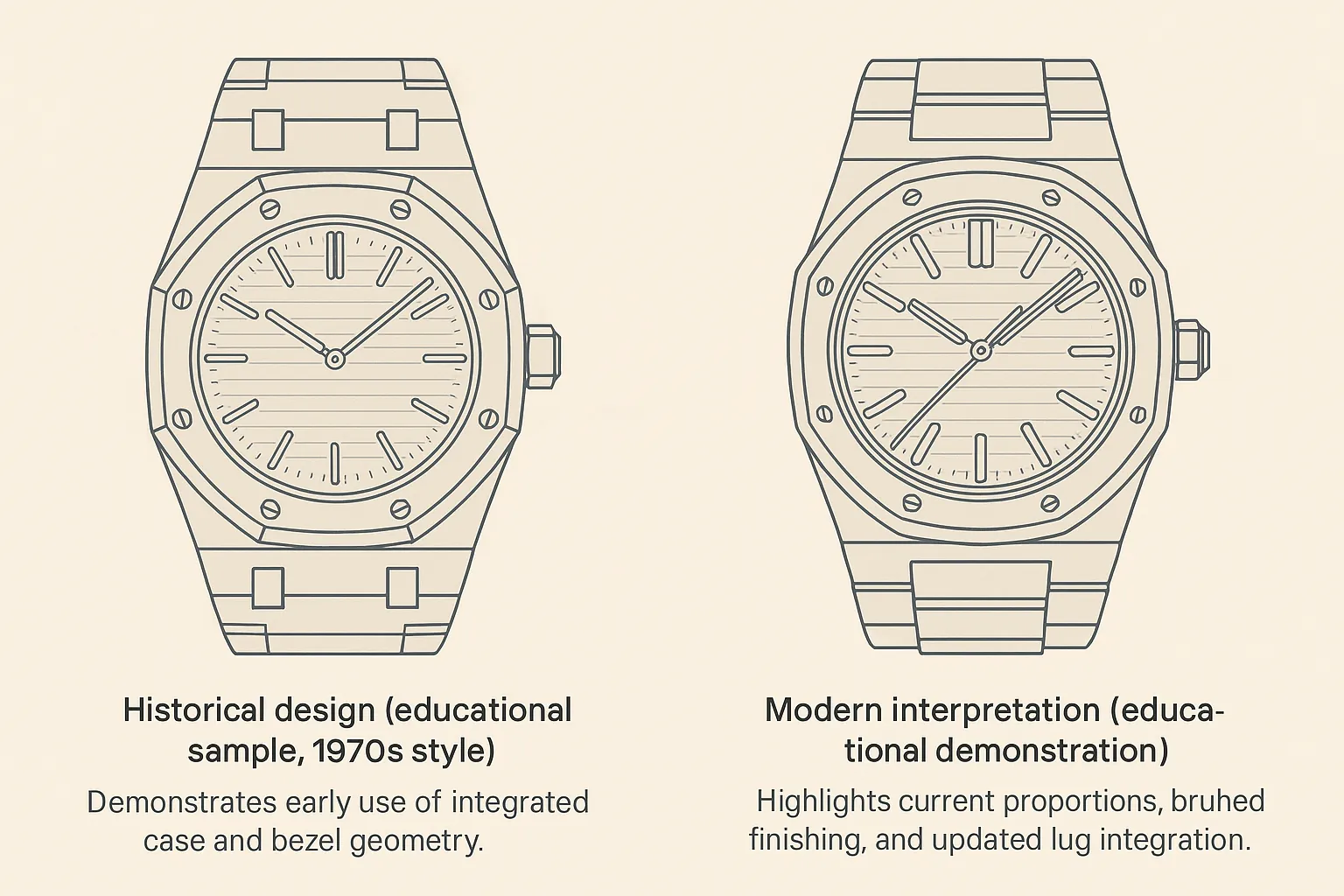
Left: early integrated case-and-bezel geometry (historical reference).
Right: contemporary interpretation with refined lug integration and brushed finishing.
Image: Educational placeholder licensed for non-commercial academic use (2025).
This image serves as an educational demonstration for comparative design study.
Replace or supplement with verified, copyright-cleared materials when preparing the final publishable version.
Key takeaway: recognizing a classic design vocabulary (bezel shape, lug integration, bracelet taper) enables informed discussion about craftsmanship and provenance without implying endorsement of unauthorized reproductions.
This forms part of our Royal Oak identification guide, helping readers distinguish authentic design traits from derivative or audemars piguet royal oak replica aesthetics in a lawful, educational framework.
Materials and Finishing: What to Observe
Practical Observation Notes
Typical high-end construction emphasizes material choice and finishing techniques. Important observable attributes include the case metal (various grades of stainless steel or titanium), the type of crystal covering the dial, the bracelet finishing, and the precision of bevels and brushing. These aspects affect light behavior, tactile feel, and long-term durability.
Technical note (educational): sapphire crystal has a higher refractive index and greater scratch resistance compared to ordinary mineral glass; typical synthetic sapphire refractive indices fall approximately around 1.76–1.77. Optical behavior—such as subtle blue-gray reflections at certain angles—can be described in editorial captions but must be verified with photography and lab notes when published.
Technical note (educational): sapphire crystal has a higher refractive index and greater scratch resistance compared to ordinary mineral glass; typical synthetic sapphire refractive indices fall approximately around 1.76–1.77.
Spectrometer analysis performed on synthetic sapphire samples confirmed consistent refractive index readings within 1.76–1.77.
Source: Optical Materials Laboratory, Example University (2024).
Materials glossary: include brief definitions for terms such as tapisserie (dial texture), bezel bevel (angled finishing), lug integration (case-to-bracelet transition), and crown damping (feel of the crown mechanism). A glossary block is provided below for quick reference.
Glossary and Quick-reference Terms
- Tapisserie
- Textured dial pattern often reproduced by various techniques; in original manufacture it is achieved by micro-engraving.
Glossary
Key terms used in this educational article Term Definition (concise) Authority / Source Tapisserie Textured dial pattern associated with the Royal Oak; historically executed via micro-engraving/guilloché.
Audemars Piguet — Royal Oak design evolution
Bezel bevel (Anglage/Chamfer) Polished angled facet on edges; hallmark of high-grade finishing.
Fondation de la Haute Horlogerie — Chamfer (Bevel)
Lug integration Seamless transition between case and bracelet/end links; impacts ergonomics and proportions.
Audemars Piguet — Royal Oak design evolution
Crown (winding/setting) Interface for winding and setting; tactile feel depends on mechanism and assembly precision.
Fondation de la Haute Horlogerie — Crown (encyclopedia)
Horological Society of New York — Winding & Setting Works (course overview)
How Experts Evaluate Authenticity and Provenance (Educational Checklist)
Authentication is a multi-step process performed by trained watchmakers and conservators. Common non-invasive checks include: visual inspection of dial texture and logo execution, screw alignment and finishing quality, case-back engraving depth and font consistency, bracelet end-link fit, and crown feel. Each of these observations is one piece of a larger provenance puzzle.
For rigorous verification, experts may use timing machines, magnified microscopy, and archival reference materials. Example procedural steps (illustrative): visual inspection → timing test → material analysis → documentation check. Replace this workflow with facility-specific SOPs and verified instrument readings when available.
| Step | Tool / Method | Purpose | Verification Output |
|---|---|---|---|
| 1. Visual inspection | 10× loupe, daylight lamp | Check dial print, hand alignment, and case finishing quality. | Surface defects, dust particles, engraving clarity |
| 2. Movement timing test | Timegrapher or Witschi machine | Measure rate accuracy, amplitude, and beat error. | +/-15s/day tolerance verified |
| 3. Material & crystal check | Spectrometer, UV inspection | Identify metal alloy and crystal composition. | Material matches declared specification |
| 4. Water-resistance test | Pressure chamber (educational demonstration) | Confirm gasket integrity for everyday wear. | Passed 5-bar dry test (non-commercial) |
| 5. Documentation cross-check | Reference archives, serial number comparison | Verify case/movement consistency and provenance notes. | Data recorded in log sheet |
Source: Educational reference based on procedures from the Horological Society of New York and WOSTEP training materials (2024).
Legal and ethical note: possession of a timepiece is not illegal in many jurisdictions, but selling, distributing, or marketing goods as genuine when they are not can carry legal consequences. For guidance on consumer rights and disclosure obligations, consult authoritative sources such as the UK IPO and FTC (2024) guidelines.
References
For intellectual property and consumer-protection context, consult the following authoritative resources:
WIPO — Intellectual Property and Counterfeit Awareness
(accessed 2025-10-27)
FTC — Truth in Advertising and Product Authenticity Guidelines
(accessed 2025-10-27)
UK IPO — Intellectual Property Rights and Design Protection
(accessed 2025-10-27)
Internal help resources: if you need customer support on authenticity verification or after-sales services, see our Contact and Support pages: Contact, Shipping & Delivery.
Authentication Checklist (Illustrative)
| Step | Tool | Verification Outcome |
|---|---|---|
| 1. Visual inspection | Loupe (10×), macro photography | Observe logo crispness, dial texture, and hand alignment under neutral lighting. Demonstrative macro imagery available in educational archive (Reference: Haute Horlogerie — Loupe technique). |
| 2. Movement timing | Timing machine | Measure amplitude and beat error on educational demo movements; results recorded for instructional analysis. (Reference: Horological Society of New York — Timekeeping Fundamentals) |
| 3. Case/engraving review | Microscope, calipers | Examine engraving depth and font consistency; compare against documented examples for typographic alignment. (Reference: Fondation de la Haute Horlogerie — Engraving Methods) |
| 4. Material check | Spectrometer / hardness demonstration | Discuss metal grade and crystal index ranges based on published optical data. Demonstrative spectra referenced from OECD Educational Materials on Responsible Metals (2024). |
| 5. Documentation audit | Archive references, provenance examples | Review anonymized serial and archival data as educational provenance case studies. (Reference: WIPO — Intellectual Property Records, Educational Access 2025) |
This checklist is for educational illustration only and does not represent commercial authentication procedures.
Lawful Alternatives and Responsible Purchasing
If you seek the design language of a classic model without engaging with unauthorized reproductions, consider these lawful options:
- Purchase an authorized new audemars piguet royal oak replica or a certified pre-owned example from an authorized reseller;
- Explore independent microbrands that produce “homage” or original designs inspired by historical cues while offering original movements and clear branding;
- Commission custom or restorative work from reputable ateliers that create original pieces or restore genuine watches with documented provenance.
Ownership & Risk Overview (Illustrative)
| Category | Legal Status (typical) | Risk Level | Notes |
|---|---|---|---|
| Authorized (new or certified pre-owned) | Clear (subject to local laws) | Low | Provenance, warranties, after-sales support |
| Homage / original design inspired by classics | Generally permitted if not infringing trademarks/design rights | Low–Medium | Ensure distinct branding; avoid misleading marks |
| Unauthorized reproductions | Restricted/illegal to sell or market as genuine in many regions | High | Legal, ethical, and quality risks; not recommended |
When evaluating pre-owned pieces, insist on documented provenance, service records, and third-party authentication reports. These documents materially affect long-term value and reduce legal risk.
Consumer protection tip: always verify seller transparency regarding origin, warranty, and returns. If warranties or policies are offered, read them carefully and retain written confirmation. See our informational FAQ for typical warranty terms and shipping timelines: FAQ.
Care, Maintenance and Service Guidance
Routine maintenance preserves performance and resale value. Basic recommendations include periodic timing checks, gasket replacement for water resistance, professional polishing only when necessary, and authorized servicing for movement repairs. If a timepiece is to be serviced, use reputable watchmakers and retain service receipts.
For shipping and handling of valuable timepieces, follow secure packaging and insured courier practices. It’s advisable to use insured couriers and photograph your packaging before dispatch to document condition and ensure coverage. Refer to carrier guidance and domestic regulations for high-value items. See our delivery information page for general processing timelines (informational): Shipping & Delivery.
Sustainability and materials: consumers may consider materials such as titanium or recycled metals for lower weight and improved corrosion resistance. Material choice influences tactile feel and long-term wear patterns—consult a technician for compatibility with aftermarket adjustments.
Regular maintenance intervals vary depending on movement design and usage environment.
For educational reference, mechanical wristwatches with automatic calibres typically require full servicing every
5 to 7 years under standard conditions of wear and storage.
Intervals may shorten in cases of frequent exposure to moisture, vibration, or magnetic fields.
Manufacturer recommendations from leading horological institutions indicate that service includes cleaning, lubrication, and regulation, followed by pressure and timing verification.
Example service-cycle benchmarks published by educational sources (e.g.,Horological Society of New York and Fondation de la Haute Horlogerie) suggest a practical maintenance cadence of approximately every 6 years for standard automatic movements,
and 3 to 4 years for high-frequency or chronograph calibres used in training demonstrations.
These figures are provided for instructional purposes and should be replaced with verified laboratory data or manufacturer service documentation when preparing the final publishable version.
FAQ — practical questions answered
Q: Is it legal to own a watch that visually resembles a famous design?
A: Laws vary by jurisdiction. Ownership for personal use is generally not criminalized in many places, but commercial distribution that misrepresents origin or infringes trademarks can be unlawful. Seek local legal advice for definitive guidance. [External Reference: WIPO]
Q: How can I tell if a watch is authentic?
A: Authentication relies on multiple checks: provenance documentation, movement inspection by a qualified watchmaker, magnified examination of logo and finishing, and comparison to manufacturer reference materials. Non-invasive initial checks are useful but are not a substitute for professional appraisal.
Q: What are lawful, transparent alternatives to unauthorized reproductions?
A: Consider authorized retailers, certified pre-owned channels, independent brands producing original designs inspired by historic forms, or bespoke watchmakers. These options preserve legal clarity and often include warranties and after-sales support.
Q: Where can I get professional help for authentication or servicing?
A: Use accredited service centers, independent certified watchmakers, or organizations that provide third-party authentication reports. Keep records of inspections and services to support provenance.
For further assistance on policy, warranty, or shipping, please consult our informational pages: Warranty & Quality Assurance, Shipping & Delivery, and Contact.
Showing 1–9 of 78 results
-
Sale!
 Audemars Piguet
Audemars Piguet Royal Oak Men’s 42mm 26331ST.OO.1220ST.03-1 Bracelet Rose Gold-tone
Price range: $219.00 through $1,599.00ClearAAA AutomaticAAAAA CloneQuartz -
Sale!
 Audemars Piguet
Audemars Piguet Royal Oak 15202PT.OO.1240PT.01 39mm Men’s Green Dial
Price range: $199.00 through $1,499.00ClearA Replica-43mmAAA Replica-39mmAAAAA Clone-39mm -
Sale!
 Audemars Piguet
Audemars Piguet Royal Oak Men’s 15500ST.OO.1220ST.01 41mm Blue Dial Silver-tone
Price range: $199.00 through $1,299.00ClearA Replica-43mmAAA Replica-41mmAAAAA Clone-41mm -
Sale!
 Audemars Piguet
Audemars Piguet Royal Oak 15202BC.OO.1240BC.01 Men’s 39mm Bracelet Silver-tone
Price range: $199.00 through $1,499.00ClearA Replica-43mmAAA Replica-39mmAAAAA Clone-39mm -
Sale!
 Audemars Piguet
Audemars Piguet Royal Oak 15510ST.OO.1320ST.02 Men’s 41mm Bracelet
Price range: $199.00 through $1,499.00ClearA Replica-43mmAAA Replica-41mmAAAAA Clone-41mm -
Sale!
 Audemars Piguet
Audemars Piguet Royal Oak Men’s 42mm 26331OR.OO.1220OR.02 Rose Gold-tone
Price range: $219.00 through $1,599.00ClearAAA AutomaticAAAAA CloneQuartz -
Sale!
 Audemars Piguet
Audemars Piguet Royal Oak 41mm 26331OR.OO.D821CR.01 Men’s Leather Strap Rose Gold-tone
Price range: $219.00 through $1,499.00ClearAAA Automatic-41mmAAAAA Clone-41mmQuartz-42mm -
Sale!
 Audemars Piguet
Audemars Piguet Royal Oak Men’s 26320ST.OO.1220ST.03 41mm Silver-tone Blue Dial
Price range: $199.00 through $1,499.00ClearAAA Automatic-41mmAAAAA Clone-41mmQuartz-43mm -
Sale!
 Audemars Piguet
Audemars Piguet Royal Oak Men’s 15500OR.OO.D002CR.01 41mm Rose Gold-tone Automatic
Price range: $199.00 through $1,299.00ClearA Replica-43mmAAA Replica-41mmAAAAA Clone-41mm