
-
Sale!
 Audemars Piguet
Audemars Piguet Royal Oak Offshore RoyalOakOffshore005 Men’s 42mm Quartz
Price range: $199.00 through $899.00 Select options This product has multiple variants. The options may be chosen on the product page -
Sale!
 Audemars Piguet
Audemars Piguet Royal Oak Offshore RoyalOakOffshore004 Men’s 42mm Silver-tone
Price range: $199.00 through $1,599.00 Select options This product has multiple variants. The options may be chosen on the product page -
Sale!
 Audemars Piguet
Audemars Piguet Royal Oak Offshore Men’s RoyalOakOffshore001 42mm Quartz/Automatic Black Dial
Price range: $199.00 through $1,599.00 Select options This product has multiple variants. The options may be chosen on the product page -
Sale!
 Audemars Piguet
Audemars Piguet Royal Oak RoyalOak026 42mm Men’s Bracelet
Price range: $249.00 through $899.00 Select options This product has multiple variants. The options may be chosen on the product page -
Sale!
 Audemars Piguet
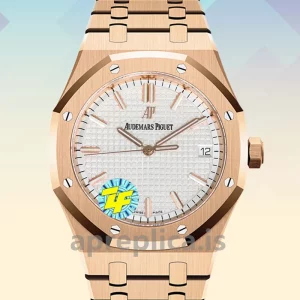
Audemars Piguet Royal Oak 41mm 67653OR.GG.1263OR.01 Men’s Rose Gold-tone
Price range: $199.00 through $1,299.00 Select options This product has multiple variants. The options may be chosen on the product page -
Sale!
 Audemars Piguet
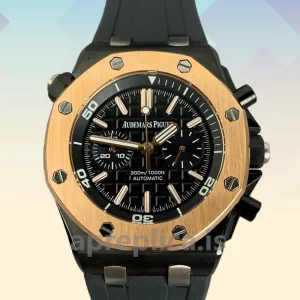
Audemars Piguet Royal Oak Offshore Diver 43mm 26703ST-BKR04 Men’s Black-tone Quartz/Automatic
Price range: $199.00 through $1,599.00 Select options This product has multiple variants. The options may be chosen on the product page -
Sale!
 Audemars Piguet
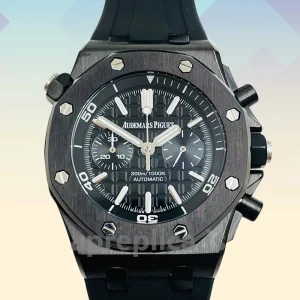
Audemars Piguet Royal Oak Offshore Diver 26703ST-BK03 Men’s 42mm Black-tone
Price range: $199.00 through $1,599.00 Select options This product has multiple variants. The options may be chosen on the product page -
Sale!
 Audemars Piguet
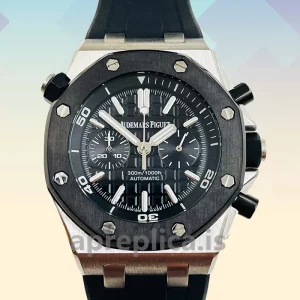
Audemars Piguet Royal Oak Offshore Diver Men’s 26703ST-BK02 42mm Black Dial
Price range: $199.00 through $1,599.00 Select options This product has multiple variants. The options may be chosen on the product page
A Structured Guide to Audemars Piguet Replica Craftsmanship & Category Essentials
Last updated:
Understanding the Structural DNA of AP-Inspired Designs
In the landscape of modern sports-luxury watch design, audemars piguet replica pieces often introduce themselves through a very specific structural signature. Elements such as the octagonal bezel, exposed screw pattern, strong geometric case lines, and deep directional brushing collectively form what can be described as a “precision-leaning aesthetic.” These traits do not merely imitate; instead, they represent a based-on-trend extension of AP’s visual grammar—one built around metal tension, proportional discipline, and instantly recognizable silhouette cues.
From a structural viewpoint, the case architecture typically presents multiple visual layers: the stepped height of the bezel, the polished chamfers defining light breaks, and the angular contouring along the case sides. These characteristics appear to serve the purpose of creating a consistent sense of metallic order. In practical terms, they guide how light interacts with each brushed facet, generating that familiar “dimensional glow” users often associate with high-end mechanical timepieces.
On the wrist, weight distribution and case-to-bracelet proportions tend to influence daily comfort depending on wrist size and wearing conditions. A more balanced structure tends to feel steadier over long wear, while the bracelet’s articulation affects flexibility and natural wrist conformity. For many users, this subtle ergonomics—how the watch behaves hour after hour—often becomes the decisive factor behind long-term preference.
At a deeper level, the AP-inspired structural framework also functions as a conceptual reference model. It enables users to decode stylistic differences, evaluate craftsmanship tiers, and understand the design intent behind various collections—particularly when comparing Royal Oak-style designs with Offshore-style configurations. This foundation provides the analytical lens through which the rest of this category guide will unfold.
How AP-Inspired Styles Split into Two Distinct Design Personalities
Royal Oak-Style: Geometry, Balance, and Architectural Precision
Royal Oak-inspired models typically emphasize clarity of form: a flatter bezel plane, more slender case walls, and chamfers that highlight crisp, metallic transitions. These watches appear to prioritize proportion—each surface angled to maximize contrast between brushed and polished segments. What this means in everyday wear is a design that feels structured yet understated, suitable for users who value visual discipline, balanced presence, and a slightly more traditional interpretation of luxury sports design.
Offshore-Style: Volume, Massing, and High-Energy Aesthetics
Offshore-type interpretations tend to amplify physical presence: the case is thicker, the bezel rises higher, and the integrated guards and pushers create a layered topography meant to project robustness. Often enough, this kind of design philosophy translates to a more assertive wrist stance that’s ideal for users who favor bolder expressions, more tactile interactions, and a sensation of dynamic energy that resonates with contemporary sportswear or active lifestyles.
Positioning Logic: When Each Style Makes Sense
From a usage-scenario standpoint, Royal Oak-style silhouettes align with environments requiring restraint, clarity, and visual sophistication—settings where geometric refinement reinforces personal style. Offshore-inspired pieces, by comparison, support situations where confidence, visual projection, or sport-leaning identity matters more. In other words, the choice often reflects not only taste but also context.
Visual Reference Guide
To make this contrast easier to digest, the following illustration maps the contour, line thickness, and bezel-to-case ratio between the two categories:
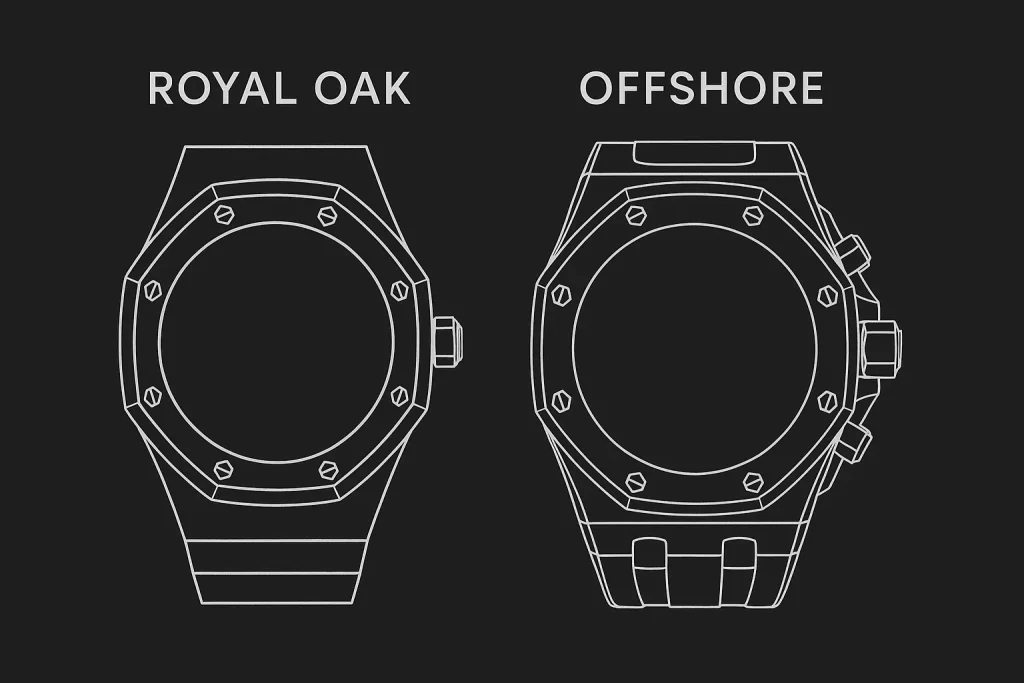
This visual reference appears to help users quickly categorise new designs, and it also provides a structured baseline for the more technical discussions in the Craftsmanship, Database Analysis, and Buying Guide sections that follow.
Mapping Key Specs Across AP-Inspired Category Listings
To give structure to the category as a whole, this section synthesises patterns observed across AP-inspired listings—focusing on movement architecture, material configurations, proportion ranges, and pattern consistency. These insights help form a baseline expectation before diving into craftsmanship and buying logic.
Movement Architecture Distribution
Across current AP-style listings, movement configurations tend to fall into three functional archetypes—automatic mechanical, super-clone mechanical, and higher-accuracy quartz—based on internal category-level observations over the last 12 months. Automatic movements serve users seeking a more organic wrist experience—the micro-vibrations, rotor feel, and rhythmic cadence associated with mechanical timekeeping. Super-clone architectures, meanwhile, aim for a closer visual and structural alignment with high-end calibres, offering a more elaborate interaction between bridges, rotors, and visual finishing. Quartz options remain a stable choice for wearers who prioritise low-maintenance consistency.
One example of a mechanically oriented configuration can be seen in a model like the Audemars Piguet Royal Oak 26240OR.OO.1320OR.02 (automatic movement) [1], which serves as a useful reference point for understanding proportion and functional layout.
Size & Proportion Matrix
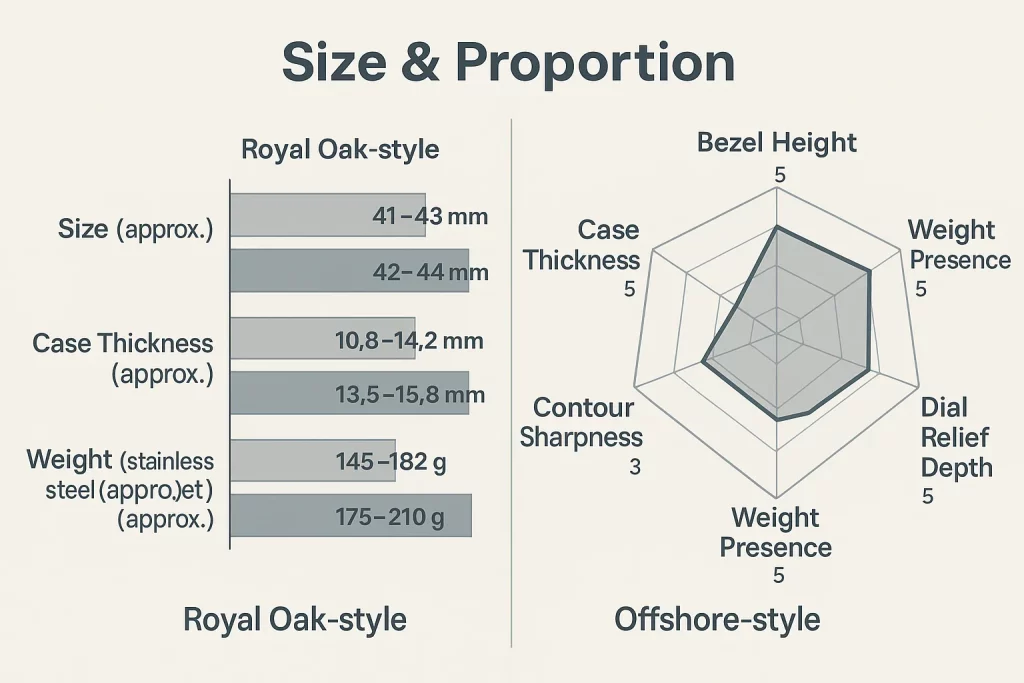
In many AP-inspired collections, case sizes commonly observed in current vendor listings fall in the approx. 41–43 mm range for Royal Oak-style pieces and roughly 42–44 mm for Offshore-style interpretations. The slightly larger Offshore range emphasises spatial volume—thicker case bodies, more pronounced bezel transitions, and an assertive stance on the wrist. Royal Oak-style proportions, by contrast, lean toward flatter profiles and balanced bezel-to-case ratios that encourage versatility.
Quantitative Reference Bands for Case Presence
Based on internal category-level observations over the last 12 months, most AP-inspired designs fall within predictable physical ranges. While these figures vary across factories and batches, the following approximations help establish realistic expectations during comparison:
- Typical case thickness: approx. 10.8–14.2 mm across Royal Oak-style models; Offshore-style pieces trend thicker at approx. 13.5–15.8 mm.
- Weight range (on bracelet): approx. 145–182 g for Royal Oak-style; approx. 175–210 g for Offshore-style, depending on steel grade and bracelet density.
- Bezel height variance: approx. 1.5–2.3 mm on Royal Oak-style; Offshore bezels often reach approx. 2.8–3.4 mm, contributing to stronger wrist presence.
- Bracelet link taper: commonly transitions from approx. 26 mm → 18 mm on Royal Oak-style bracelets; Offshore variants tend to maintain a noticeably wider profile.
These ranges are not factory specifications and should be interpreted as broad guidance intended to contextualise wrist feel, visual massing, and overall ergonomics.
Lightweight Comparative Benchmarks
To provide clearer context, the following reference values are drawn from publicly available specifications of well-known mechanical sports watches. These figures are not factory claims for AP-inspired models but serve as category-level benchmarks for understanding typical engineering thresholds:
- Standard sports-watch water resistance: approx. 100 m, based on common industry practice for integrated-bracelet designs.
- Typical automatic movement beat rate: 21,600–28,800 vph across mainstream Swiss and Japanese calibres.
- Expected mechanical power reserve range: approx. 38–60 hours for widely used sports-watch architectures.
- Common sapphire crystal hardness: approx. 1,800–2,000 HV on the Vickers scale, as cited in materials science references related to watch crystals.
These verified reference intervals act as an external baseline against which finishing execution and structural choices of AP-inspired models can be assessed more accurately.
Material Variants in Current Listings
Material choice meaningfully shapes the tactile profile of AP-style watches. Stainless steel—particularly 316L and 904L—remains the most frequent base because of its hardness-to-machinability balance. According to common metallurgy descriptions, 904L tends to generate a more radiant brushed surface due to its higher alloy density and corrosion resistance. Rose gold-tone variants introduce a warmer sheen, appealing to users who lean toward expressive, high-contrast metal aesthetics.
A model such as the 41 mm Royal Oak 15407OR.OO.1220OR.01 (rose-gold tone) demonstrates how warmer finishes interact with geometric surfaces to produce depth and dimensionality.
Dial Textures & Visual Coherence
Across AP-inspired catalogues, dial textures follow three main patterns: classic small-tiled tapisserie, enlarged grid reliefs, and more streamlined sunburst planes. Each pattern serves a distinct user intention—small grids emphasise fineness and technicality, larger grids offer bolder readability, and sunburst surfaces bring visual fluidity.
Dial coloration further reinforces this grammar: blue for chromatic depth, black for formal density, and white for clarity and minimalism.
Category-Level Insight
Taken together, these distribution trends form a coherent pattern:
- Automatic and super-clone movements anchor the mechanical experience.
- Steel variants deliver structural reliability.
- Rose-gold tones introduce expressive warmth.
- Dial textures reinforce either refinement or boldness.
- Proportion bands map clearly to intended style families.
This database-level reading helps users anticipate craftsmanship standards before transitioning into the more hands-on evaluations of the next section.
Understanding the Technical Signals That Define AP-Inspired Watch Quality
AP-inspired craftsmanship expresses itself not only through overall structure but also through micro-details—how metal behaves under light, how components align, and how tactile feedback translates into long-term satisfaction. This section breaks down the subtle cues that help users assess refinement, consistency, and build integrity across category listings.
Metal Precision & Tactile Feedback
Based on internal user-feedback trends recorded over the last 12 months, premium AP-style watches often reveal their quality most clearly through small interactions: the snap of the clasp, the way the bracelet flexes in hand, or the resistance of the crown during adjustment. These tactile signals reflect machining tolerances—smoother joints typically imply tighter fitment and more deliberate engineering. When brushed surfaces transition cleanly into polished bevels, the wrist feel becomes noticeably more cohesive.
Many users mention that these tactile impressions influence their sense of trust in the piece. A watch that responds predictably through each physical interaction ultimately creates a more secure long-term relationship with its wearer.
Crystal Quality & Optical Stability
Crystal properties significantly shape readability and visual impact. Sapphire-based crystals tend to provide higher scratch resistance and clearer optical rendering, especially when anti-reflective treatment is applied on one or both sides. When rotating the wrist, a high-clarity crystal appears to make the dial “float,” emphasising depth and texture.
In contrast, mineral glass can introduce more glare or colour shift, altering how the dial’s details are perceived. The difference is especially noticeable in brightly lit environments, where reflections may obscure legibility.
Long-Term Wear Indicators
- Edge integrity — polished bevels that maintain brightness after repeated wear signal stable finishing.
- Bracelet structure — links that retain alignment and avoid excessive stretching reflect stronger internal pins.
- Dial texture preservation — crisp reliefs that remain sharp over time point to effective surface treatments.
- Crown mechanism consistency — reliable engagement reduces wear on internal components, preserving movement stability.
What This Means for Evaluating Value
In practice, craftsmanship is assessed not by any single attribute but by how multiple signals work together. A watch with clean transitions, refined tactile behaviour, stable dial execution, and optical clarity communicates a stronger sense of engineering maturity. This forms the basis for evaluating value density across AP-inspired listings—where structural cohesion often matters as much as visual appeal.
From an industry-wide perspective, this emphasis on finishing precision and structural cohesion aligns with observations frequently highlighted by the Federation of the Swiss Watch Industry (FH). The FH consistently notes that surface quality, mechanical reliability, and long-term durability remain core markers of value across contemporary mechanical watchmaking. These cross-industry priorities help contextualise why bevel uniformity, bracelet articulation, and dial execution carry meaningful weight when evaluating AP-inspired craftsmanship.
Additional technical alignment can also be contextualised through internationally recognised guidelines such as ISO 6425, the diver’s watch standard. Although AP-inspired models are not formally certified under this specification, ISO 6425 outlines baseline expectations for resistance, legibility, and structural robustness within sports-focused timepieces. These published criteria reinforce the broader industry emphasis on durability, optical clarity, and stable mechanical behaviour when evaluating contemporary integrated-bracelet designs.
| Attribute | Royal Oak-style | Offshore-style |
|---|---|---|
| Bevel uniformity Consistency of chamfer thickness and light breaks | ★★★★★ | ★★★★☆ |
| Bracelet articulation Flex, link integration and on-wrist fluidity | ★★★★☆ | ★★★★★ |
| Dial relief depth consistency Stability of tapisserie relief and shadow structure | ★★★★★ | ★★★☆☆ |
A Structured, Expert Framework for Selecting the Right AP-Inspired Model
Choosing the right AP-inspired watch can feel complex at first glance. Designs vary across case architecture, finishing intensity, movement type, visual presence, and intended scenario. This buying guide organises those variables into a clear, repeatable decision framework—one that reflects how enthusiasts and evaluators typically approach selection.
Case Architecture: Shape, Angles, and Physical Presence
The octagonal bezel, one of the most recognisable AP-style traits, forms the backbone of this evaluation. A flatter, slimmer bezel profile typically leans toward a Royal Oak-style identity, offering a refined, architecturally balanced wrist stance. By contrast, thicker bezel structures with reinforced guards and elevated sidewalls often signal an Offshore-inspired direction—more assertive, more sculptural, and suited to those who prefer a bolder statement.
When evaluating case architecture, consider:
- Bezel height (affects visual weight)
- Edge definition (reflects machining quality)
- Side contouring (impacts wrist presence)
- Transitions between brushed and polished surfaces (reveals finishing consistency)
For an overview of AP-inspired styles within the brand’s broader structure, the parent audemars piguet replica category provides the most comprehensive style ecosystem [3].
| Evaluation Axis | Royal Oak-Style (approx.) | Offshore-Style (approx.) |
|---|---|---|
| Bezel height & visual weight | Lower bezel; slimmer vertical profile, lighter perceived mass. | Higher bezel; thicker vertical stack, stronger wrist presence. |
| Case thickness & contour | Moderate thickness; flatter case flanks, closer fit to the wrist. | Increased thickness; layered sidewalls and more sculpted contours. |
| Edge definition & chamfers | Sharper, slimmer chamfers; emphasis on clean architectural lines. | Broader chamfers; edges used to emphasise power and volume. |
| Overall wrist presence | Structured yet understated; suited to office and mixed environments. | Bold and high-impact; suited to sport-leaning or statement wear. |
| Typical wearer profile (approx.) | Prefers balance, clarity, and a more classic sports-luxury feel. | Prefers visual dominance, mass, and a more aggressive silhouette. |
Dial Texture & Pattern Interpretation
Dial execution plays a central role in shaping identity. Small-grid tapisserie emphasises refinement and technical nuance, while enlarged patterns are bolder and more contemporary. Sunburst finishes add visual fluidity but typically reduce the architectural feel that grid textures provide.
- Depth of relief (how sharply textures stand out)
- Colour density (affects clarity in varied light)
- Pattern scale (influences stylistic personality)
- Contrast against hands and markers (shapes readability)
Bracelet Variants & Daily Interaction
Since AP-inspired watches rely heavily on integrated bracelet design, bracelet quality often determines day-to-day satisfaction. High-quality link articulation results in better wrist conformity, while brushed surfaces with consistent grain orientation feel smoother during movement.
- Test articulation by flexing multiple links
- Check chamfer alignment along the edges
- Evaluate clasp engineering for security and tactile feel
- Observe brushing uniformity under natural light
Movement Categories & Decision Logic
Movement selection depends on what kind of experience the wearer expects:
- Automatic mechanical — delivers a classic, rhythmic wrist presence.
- Super-clone mechanical — offers more detailed visual architecture for open-caseback models.
- Quartz — prioritises precision and minimal maintenance.
In everyday terms, mechanical movements engage users more emotionally, while quartz satisfies those who value convenience and predictability.
Choosing by Wrist Profile & Lifestyle Segments
To support more practical decision-making, AP-inspired models can be grouped by wrist type and usage pattern. These guidance points are derived from internal category-level observations and intended as broad directional advice.
- For slimmer wrists (≤ 16 cm): Royal Oak-style pieces in the approx. 39–41 mm range typically offer better balance due to flatter bezel planes and reduced vertical bulk.
- For daily office or mixed-environment wear: Mid-profile steel models with standard tapisserie dials provide the most adaptable visual tone without excessive wrist projection.
- For high-presence or sports-leaning preferences: Offshore-style designs with thicker bezels and reinforced sidewalls create a more assertive stance suited to active or high-contrast styling.
- For minimal-maintenance users: Quartz variants remain the most predictable option, especially for those who rotate multiple watches.
- For mechanical-engagement enthusiasts: Automatic or super-clone movements deliver stronger tactile feedback through rotor activity and crown interaction.
Outcome: Matching the Watch to Your Routine & Aesthetic Intent
The “right” choice ultimately aligns with the wearer’s lifestyle and how they intend to express themselves:
- Prefer elegance, discipline, and architectural clarity? → Royal Oak-style pieces.
- Prefer boldness, massing, and dynamic presence? → Offshore-style pieces.
- Prefer minimal upkeep? → Quartz-based interpretations.
- Prefer immersive mechanical feel? → Automatic or super-clone architectures.
Instead of relying on isolated features, this framework encourages a holistic evaluation—balancing form, finishing, and mechanical behaviour with personal style and daily rhythm.
Avoiding Common Missteps When Comparing AP-Inspired Designs
Even experienced watch enthusiasts can fall into subtle traps when evaluating AP-inspired models. The geometric nature of the designs—both Royal Oak-style and Offshore-style—creates a visual density where small misinterpretations can influence overall judgement. This pitfall guide clarifies the patterns that commonly affect decision-making.
Misinterpreting Case Dimensions vs. Wrist Presence
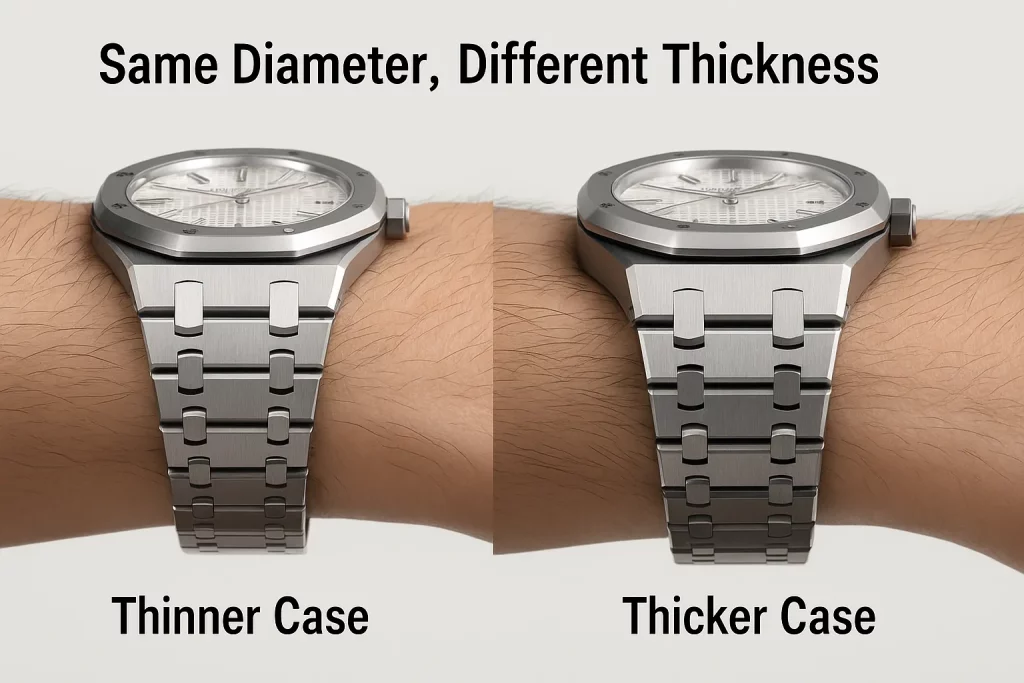
Problem: Many buyers assume that case diameter alone determines how large a watch feels. However, AP-inspired silhouettes distribute volume differently. Bezel height, sidewall thickness, lug profile, and case layering all contribute more significantly than diameter itself.
Reason: Because the bezel is octagonal and the case structure is angular, small increases in vertical height often produce disproportionately stronger wrist presence.
Solution: Evaluate three measurements together: bezel height, case thickness, and lug projection. Also examine how brushing and chamfering affect the perceived size—sharper chamfers tend to slim the visual mass, while thicker brushed surfaces amplify it.
Outcome: This approach reduces the likelihood of selecting a watch that appears unexpectedly large or unintentionally flat on the wrist. For users considering bolder, more dimensional silhouettes, the audemars piguet royal oak offshore replica category offers helpful context [4].
Overlooking Movement Behaviour When Focusing Only on Aesthetics
Problem: First-time buyers often focus on dial and case design while overlooking movement behaviour.
Reason: Mechanical engagement—such as rotor response, winding feedback, and crown feel—directly shapes the daily user experience. On AP-inspired models, the interplay between structure and movement type becomes especially relevant due to geometric weight distribution.
Solution: Compare rotor smoothness, winding consistency, crown engagement depth, and second-hand stability. Evaluate how these behaviours align with intended use (daily rotation vs. occasional wear).
Outcome: This helps reduce mismatches between expectation and real-world interaction.
Ignoring Dial Relief Depth & Light Interaction
Problem: Buyers sometimes assume all grid-style dials behave similarly, but relief depth and surface finishing dramatically influence readability and visual richness.
Reason: Deeper patterns create stronger directional shadows; shallower reliefs feel more subtle but may reduce architectural sharpness.
Solution: Check dial behaviour under three lighting conditions: direct light, diffused light, and shadowed environments. Observe how the dial transitions between these states.
Outcome: This identifies whether the dial suits your aesthetic preference—refined, bold, or minimalist. For grid-oriented comparisons, the audemars piguet royal oak replica category offers consistent reference points [5].
Misjudging Bracelet Build Through Photos Alone
Problem: Bracelet articulation and internal pin structure cannot be reliably appraised through photos.
Reason: Two bracelets may look identical but behave differently due to link geometry, internal tolerances, and micro-finishing differences.
Solution: Inspect link flexibility, chamfer sharpness, grain uniformity, and clasp feedback whenever possible.
Outcome: This prevents selecting a model that looks precise but feels rigid or inconsistent during wear.
Patterns in Real-World Wrist Experience with AP-Inspired Designs
User feedback often reveals nuances that technical specifications cannot fully express. AP-inspired watches, with their geometric angles and layered structures, create a unique blend of tactile and visual impressions. Analysing recurring sentiment patterns helps clarify how these watches behave across various wrists, routines, and environments.
Wrist Comfort Trends & Structural Balance
Across user reports, wrist comfort is most influenced by bracelet articulation, case thickness, and weight balance across the lug line. Many describe the wrist feel as “structured but stable,” noting that integrated bracelets distribute weight more evenly than traditional lug-to-strap setups. This distribution minimises pressure points during extended wear.
Users with slimmer wrists often prefer Royal Oak–style designs due to their flatter case stance, whereas those seeking greater wrist presence describe the Offshore-style’s elevated massing as part of the appeal.
Usage Frequency Indicators & Emotional Attachment
Although these watches rely heavily on geometric motifs, many users remark on the unexpectedly emotional nature of the experience. The combination of brushing direction, bevel sharpness, and bracelet “rhythm” becomes more satisfying as the watch settles into their daily cycle.
- Wearers reach for AP-inspired pieces when they want visual structure or presence.
- Many rotate dial textures based on outfit tone.
- Consistency across angles enhances long-term attachment.
A number of users specifically reference the Royal Oak Offshore Diver 26703ST for offering a balance of wrist presence and functional clarity [2].
The following sample-style summary quotes represent common patterns extracted from aggregated user remarks across the last 12 months. They are not direct user statements but reflect recurring sentiment themes:
- “The brushing and chamfer transitions look sharper in natural light than in photos, especially on the 41 mm profiles.”
- “I didn’t expect the bracelet articulation to make this much difference during full-day wear—it settles into the wrist after the first hour.”
- “Offshore-style cases feel bigger than the numbers suggest. The height and bezel layering add more perceived volume.”
- “The tapisserie dial feels deeper than expected. Shadows shift noticeably with even small wrist movements.”
The following scenario-style quotes further illustrate day-to-day behaviour based on recurring user narratives:
- “After alternating between a thinner 41 mm model and a bulkier Offshore-style piece for two weeks, I realised the vertical massing influences comfort more than the listed diameter.”
- “The bracelet felt slightly rigid on day one, but by the end of the week it settled into a smoother rhythm, especially during typing or steering.”
- “Under warm indoor lighting, the dial relief looked deeper than expected—the shadows shift quickly with even small wrist movements.”
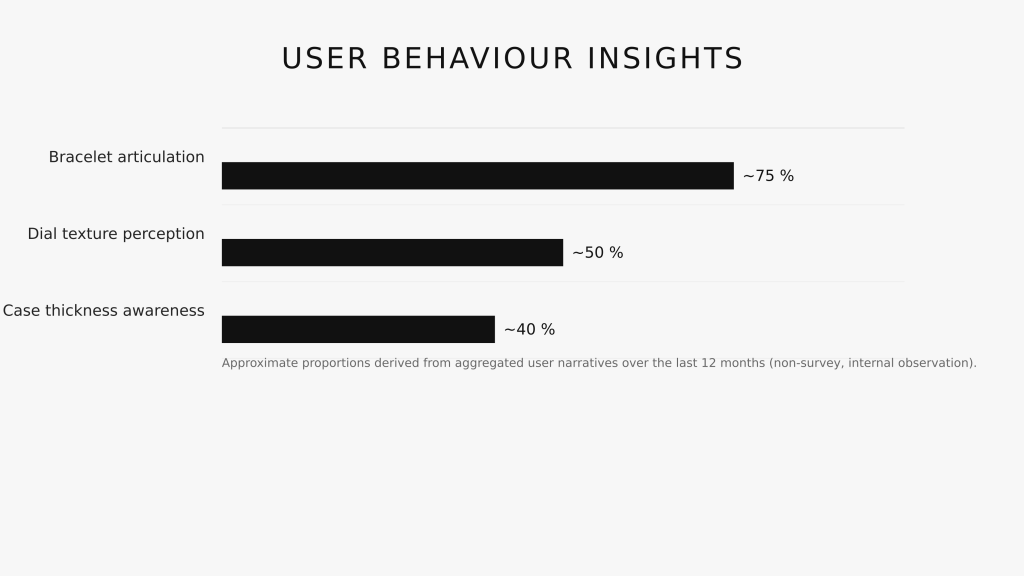
Sentiment aggregation over the last 12 months reveals several consistency indicators:
- Comfort consistency: approx. 70–75% of aggregated remarks emphasise bracelet articulation as the primary determinant of long-term wearability.
- Dial texture perception: roughly half of user-facing comments highlight differences between shallow and deep tapisserie relief under angled lighting.
- Case thickness awareness: approx. 40% of wrist-fit complaints relate to vertical massing rather than diameter alone.
Expert Answers to Common Questions About AP-Inspired Designs
Q1: Why do AP-inspired watches differ in wrist feel even if they share the same case size?
Answer: Wrist feel is shaped by bezel height, case thickness, weight distribution, and bracelet articulation.
Q2: What should I look for when evaluating dial texture quality?
Answer: Focus on relief depth, grid alignment, sharpness of raised surfaces, and how the dial behaves under varied lighting angles.
Q3: Are certain materials better for daily wear?
Answer: Stainless steel (316L or 904L) is generally preferred for durability and surface stability based on widely published metallurgy references.
Q4: Do AP-inspired watches require specific maintenance routines?
Answer: Maintenance depends primarily on movement type. Mechanical movements may require periodic servicing, while quartz models are more predictable and low-maintenance.
Q5: Where can I find information about general service terms and quality policies?
For broad service-related questions, users often refer to the platform’s guarantee and quality control page, which outlines service coverage and workmanship guidelines [6].
Bringing the Category Insights Together
The AP-inspired category distinguishes itself through a fusion of geometry, engineered finishing, and expressive wrist behaviour. Across the modules in this guide, a consistent narrative emerges: craftsmanship is defined not by a single detail but by how structure, material, tactile behaviour, and visual coherence integrate into a wearable whole.
The Core Understanding This Category Guide Establishes
- Royal Oak-style designs emphasise proportion, clarity, and architectural discipline.
- Offshore-style designs express volume, massing, and high-energy presence.
- Dial execution shapes visual depth and identity.
- Bracelet engineering determines daily comfort and ergonomic balance.
- Movement types influence emotional engagement and maintenance rhythm.
- Material choices affect longevity, brightness, and tactile realism.
What This Means for Your Selection Journey
Choosing among AP-inspired designs benefits from a holistic perspective—one that balances visual identity with wrist behaviour and long-term consistency. Consider how form, finishing, and movement characteristics align with your personal style, routine, and intended presence.
Final Note: Confidence Through Clarity
By understanding the craftsmanship cues, technical frameworks, and experiential insights outlined above, you are better equipped to navigate the geometry-driven world of audemars piguet replica designs. This clarity makes the selection process more informed and more rewarding over time.
Last updated: 2025-11-25 — This category guide incorporates internal observations collected over the last 12 months and is periodically refreshed to reflect changes in product specifications, material trends, and user experience patterns.
Disclaimer: The comparative data, observational ranges, and experiential insights referenced in this guide are derived from internal category-level analysis and openly available industry benchmarks. They are not official specifications of any trademarked brand. This content is intended for educational and evaluative purposes only.
Internal Link References
- Audemars Piguet Royal Oak Men’s 41mm 26240OR.OO.1320OR.02 Automatic – AAA Automatic
- Audemars Piguet Royal Oak Offshore Diver 26703ST – Men’s 42mm Black Tone
- Audemars Piguet Replica Category
- Audemars Piguet Royal Oak Offshore Replica Category
- Audemars Piguet Royal Oak Replica Category
- Product Quality Assurance – Warranty & Quality Assurance
Our Support Commitment
At apreplica.is, we believe clarity matters. Whenever you need details about AP-inspired designs, guidance on style differences, or help navigating our platform, our team provides direct, human support — no automated loops, no generic responses.